If your property backs onto a public laneway, you could be sitting on one of the best value-add opportunities in Toronto real estate right now.
A laneway suite lets you build a fully self-contained rental home in your backyard — without buying more land, severing your lot, or dealing with a condo board. For the right property, that’s thousands of dollars in additional monthly income on a lot you already own.
This guide covers what laneway suites are, whether your lot qualifies, what the current rules say, what they cost, and how to think about the return.
What Is A Toronto Laneway Suite?
A laneway suite is a detached, self-contained residential unit built at the rear of your property, with its entrance facing a public laneway. It connects to your main home for utilities — water, sewer, hydro, and gas — but it’s a completely independent living space.
It cannot be severed or sold as a separate property. You own it as part of the same lot. But you can rent it out, and that’s where the opportunity is.
Most laneway suites are one to two storeys and range from a compact one-bedroom up to a large two-bedroom plus den. The right size depends on your lot, your budget, and your rental income goals.
If you’re comparing laneway suites to other ways of adding density, check out our guide to creating a multiplex in Toronto and our Toronto sixplex and multiplex rules breakdown. If your lot doesn’t have a laneway, a garden suite may be the right alternative.

Why Toronto Investors Are Building Laneway Suites
Laneway suites typically cost $300 to $400+ per square foot to build depending on build requirements, finishes, and who’s managing the project. That’s roughly half the all-in cost of buying a downtown Toronto condo — for the same rent.
A well-located two-bedroom laneway suite in Toronto rents for $3,000 to $3,300 per month. Here’s how that stacks up against a condo purchase at the same rent level:
| 2BR Laneway Suite | 2BR Toronto Condo | |
|---|---|---|
| All-In Cost | $400,000 | $750,000 |
| Monthly Rent | $3,200 | $3,200 |
| Monthly Expenses | -$150 | -$1,000 |
| Monthly NOI | $3,050 | $2,200 |
| Cap Rate (approx.) | ~9% | ~3.5% |
Same rent. Half the cost. Significantly better return.
To understand how cap rates work and why they matter when evaluating a laneway suite, read our guide to cap rates in Toronto real estate. If you want to model the full return — including cash flow, equity paydown, and appreciation — use our Total Return Calculator.
If you refinance at 80% LTV after construction, you can pull out a significant amount of equity — reducing your net capital deployed and improving your cash-on-equity return even further. And because the rental income shows up on your mortgage application, it can also improve your debt servicing ratios and help you qualify for your next purchase. This pairs well with strategies like the Smith Maneuver, which some investors use to make mortgage interest tax-deductible on income-producing properties.
Does Your Property Qualify?
Laneway suites are only permitted on certain lots. Before getting too far ahead, check these four things.
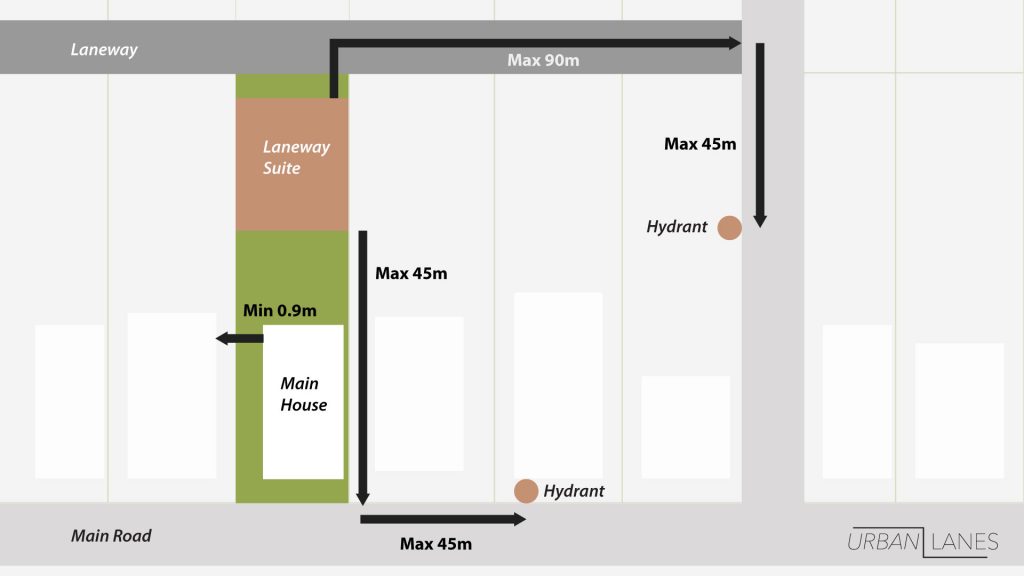
1. You need a public laneway. Your rear or side lot line must abut a public laneway for at least 3.5 metres (11.5 ft).
2. Fire access must work. The entrance to your laneway suite must be within 45 metres (148 ft) of a public street via the laneway, or within 90 metres (295 ft) if the access route goes through the main house. There must also be a clear, unobstructed path at least 0.9 metres (3 ft) wide leading to the entrance.
3. No protected trees in your build zone. Any tree with a trunk diameter of 30 cm (12 in) or more is protected under Toronto’s Private Tree By-law. The city regularly refuses removal permits for healthy trees.
4. The right zoning. Laneway suites are permitted on R-zoned lots with detached, semi-detached, duplex, or row houses. They are not permitted in MCR or CR zones.
If you’re unsure, a site assessment with an architect is the right first step before spending a dollar on design.

How To Make A Multiplex In Toronto: Your Complete Guide!
2026 Laneway Suite Rules in Toronto
The rules below reflect Toronto’s Zoning By-law 569-2013, updated by By-law 847-2025 following Ontario Regulation 462/24, which came into effect in November 2024.
Footprint and Size
The maximum footprint is 60 m² (645 sq ft), within maximum dimensions of 8.0 metres (26 ft) wide by 10.0 metres (33 ft) deep. Maximum 2 storeys. Total floor area across both storeys cannot exceed the above-grade floor area of the main house.
This means the maximum above-grade is capped at 120m² (1290 sq ft).
Height
Height is tied directly to how far the suite sits from the main house:
| Separation from Main House | Max Height |
|---|---|
| 4.0 m to less than 7.5 m (13 ft to 24.5 ft) | 4.0 m / 13 ft — 1 storey |
| 7.5 m or greater (24.5 ft+) | 6.0 m / 20 ft — 2 storeys |
The old angular plane (sloped roof) requirement has been fully removed under the 2025 bylaw update. Flat and shed roofs are now permitted.

Setbacks
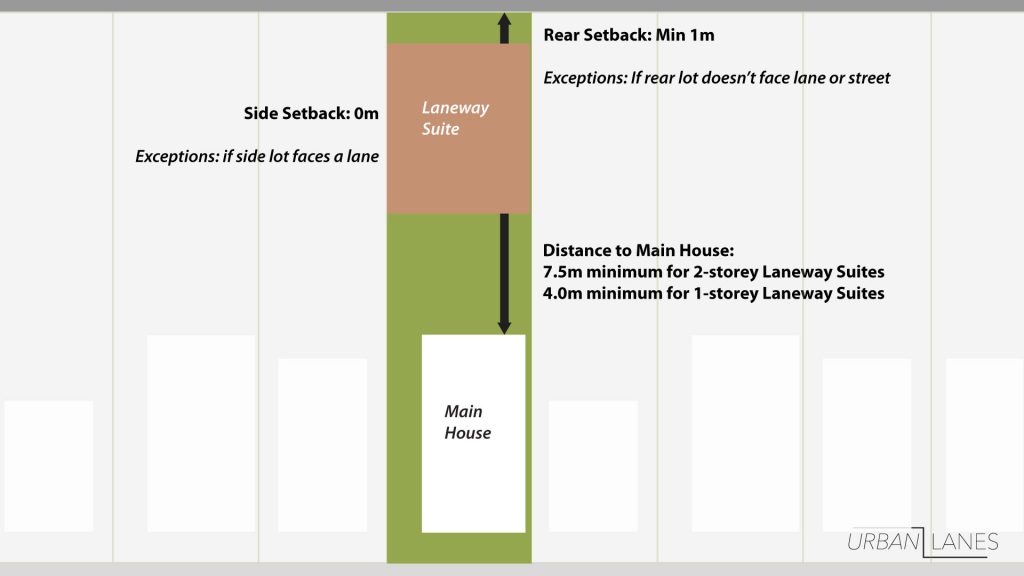
Rear lot line (facing the laneway): 1.5 m (5 ft) minimum.
Side lot lines not facing a lane or street: 0.0 m — you can build lot line to lot line, as long as there are no doors or windows on that wall.
Side lot line facing a lane or street: 1.5 m (5 ft) minimum.
Separation from Main House
4.0 m (13 ft) minimum if the suite is 4.0 m (13 ft) tall or less.
7.5 m (24.5 ft) minimum if the suite is taller than 4.0 m (13 ft).
Landscaping
Lots 6.0 m (20 ft) wide or less: minimum 60% soft landscaping in the rear yard zone between the main house and the suite.
Lots greater than 6.0 m (20 ft) wide: minimum 85% soft landscaping in that zone.
Within the 1.5 m (5 ft) laneway setback: 75% must be soft landscaping.
Parking and Bikes
No car parking required. 2 bike parking spaces required.
What Does a Laneway Suite Cost to Build?
Hard costs run $300 to $400+ per square foot depending on build requirements, finishes, and who’s managing the project. On top of hard costs, budget for soft costs including survey, architectural drawings, engineering, HVAC design, development charges, and building permit fees.
Smaller units cost more per square foot because fixed costs don’t scale down proportionally — a permit, a survey, and a set of drawings cost roughly the same whether you’re building 400 sq ft or 645 sq ft.
The City of Toronto offers a 20-year interest-free deferral on development charges for laneway suites. If you sell or refinance before the 20 years is up, the full amount comes due. Factor that into your exit strategy.
What's the Impact on Property Value?
The resale market for homes with laneway suites is still relatively new, so comparable sales data is limited. That said, income-producing properties are typically valued by investors using cap rates. At a 5.5% market cap rate, $3,050 per month in NOI implies roughly $665,000 of income-based value. That’s a meaningful lift, and it compounds over time as rents grow.
To learn more about how investors value income properties, read our full guide to cap rates in Toronto real estate.
How Many Units Can You Have on the Lot?
Under Toronto’s current zoning, you can build up to 4 units on any residential lot as-of-right, plus one laneway suite for a total of 5 units (4+1). On lots that qualify for a sixplex, you can build up to 6 units plus a laneway suite for a total of 7 units (6+1).
Development charges are waived entirely for builds up to 6 units. If you’re building a 6+1, the DC on the laneway suite can be deferred interest-free for 20 years.
A laneway suite and a garden suite cannot both be built on the same lot. It’s one or the other. If your lot doesn’t have laneway access, read our guide to Toronto garden suites to see if that’s a better fit.
For a full breakdown of how density permissions work across the city, see our Toronto multiplex and sixplex rules guide.
Quick Qualification Checklist
- Does your rear or side lot line have a public laneway?
- Is the suite entrance within 45 m (148 ft) of a public street via the lane, or 90 m (295 ft) via the main house?
- Is there a clear 0.9 m (3 ft) wide unobstructed path to the entrance?
- Is the backyard free of protected trees in the build zone?
If you can check all five, a conversation with an architect is your logical next step.
Frequently Asked Questions
Can I build a laneway suite on any Toronto property?
No. Your lot must abut a public laneway for at least 3.5 m (11.5 ft), be R-zoned, and meet fire access and tree protection requirements. A site assessment will confirm eligibility.
How big can a Toronto laneway suite be?
The maximum footprint is 60 m² (645 sq ft) per floor, within maximum dimensions of 8.0 m (26 ft) wide by 10.0 m (33 ft) deep. A two-storey build gives you up to 1,290 sq ft of total floor area, subject to the main house GFA limit.
How much does it cost to build a laneway suite in Toronto?
Hard costs typically run $300 to $400+ per square foot depending on finishes, build requirements, and project management. Soft costs — design, permits, engineering, and development charges — add to that total.
Can I sever and sell my laneway suite separately?
No. A laneway suite cannot be severed from the main lot or sold as a separate property under current Toronto zoning rules.
Can I have both a laneway suite and a garden suite on the same lot?
No. Toronto zoning permits one accessory dwelling unit per lot — either a laneway suite or a garden suite, not both.
Do I need parking for a laneway suite?
No car parking is required. You do need to provide 2 bike parking spaces.
Does a laneway suite increase property value?
Resale data is still limited, but a cash-flowing laneway suite adds meaningful income-based value. At a 5.5% cap rate, $3,050/month in NOI implies roughly $665,000 in investor-assessed value.
Can I use the Smith Maneuver with a laneway suite?
Potentially yes — if you refinance after the build and use the proceeds to invest, the interest on that portion of the mortgage may be tax-deductible. Read our full breakdown of the Smith Maneuver strategy to see if it fits your situation.
Thinking About Building a Laneway Suite?
Most investors don’t know what to look for when buying a property with laneway suite potential.
Wrong lot depth, no usable rear yard, protected trees, a garage that needs to come down — it’s easy to buy something that doesn’t work.
We screen for all of it before you make an offer. We work with Toronto investors buying properties with laneway suite potential across the city.
If you want to learn more about how this investment opportunity looks like, book a strategy call with us here.

